
One of the most expensive audiobook mistakes is making the voice decision too late. I have seen people finish editing, design the cover, plan the launch, and only then ask who should actually narrate the book.
By that point, they are tired, over budget, and usually making the choice based on panic instead of fit.
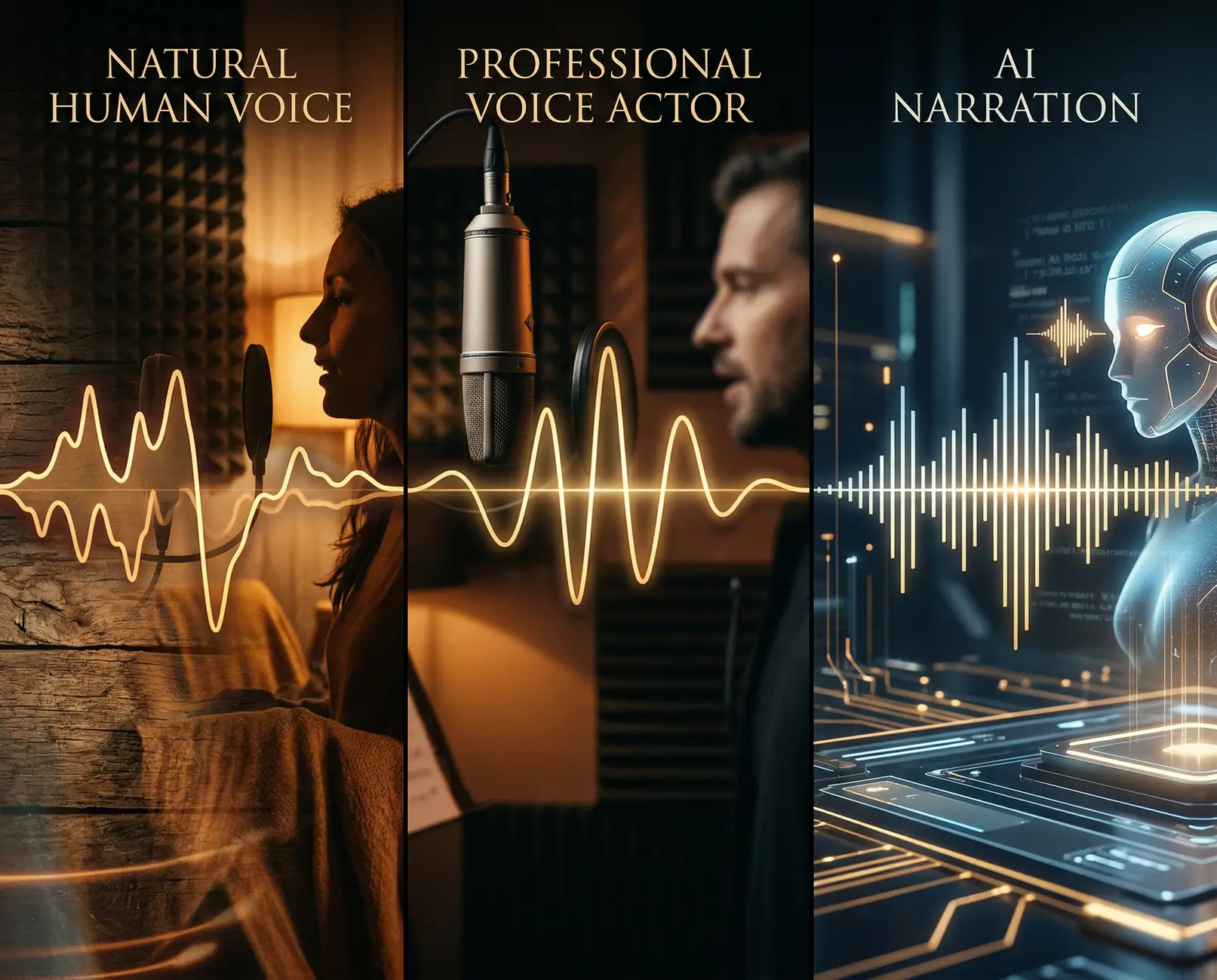
If you are creating an audiobook in 2026, you have three realistic paths in front of you. You can narrate it yourself, hire a voice actor, or use AI voice narration. Each option can work. Each one can also go badly for different reasons.
And this is where beginners often get misled. They treat the question like it is about cost alone.
It is not.
It is about the kind of listening experience you want to create, the role your voice plays in the book, how much control you want, how much editing you can tolerate, and whether this audiobook is a one-off release or part of a bigger digital publishing system.
The real question is not, “What is the cheapest way to make an audiobook?”
It is, “What voice makes this book easier, more enjoyable, and more believable to hear?”
That answer changes depending on the project.
A memoir, personal business book, devotional, or teaching-based nonfiction often benefits from the author’s own voice. A thriller with six major characters may not. A short guide that lives inside a subscriber library may not need the same production approach as a full retail audiobook release.
So before choosing a method, look at the book itself.
Read three pages out loud.
Then ask yourself if the voice in your head matches the experience your listener should have.
There are times when the author should absolutely be the narrator.
If the book is personal, instructional, or built around your perspective, your voice carries authority in a way no one else can fully copy. Readers who already know your work often want that connection. They want to hear your phrasing, your pauses, your personality.
This is especially true in nonfiction.
If you teach, coach, write from lived experience, or have a strong audience relationship, your voice can add trust. Even slight imperfections may feel human rather than distracting.
But here is the part people underestimate.
Writing a book and narrating a book are different skills.
A lot of authors assume they will sound natural because they know the material. Then they sit down at the mic and discover they sound flat, too fast, or oddly tense. I have watched confident writers get rattled by page three because narration exposes every rushed sentence and every clunky transition.
It can be humbling.
Narrating your own audiobook usually makes sense when the voice of the author is part of the product, when the tone is conversational, when the book does not demand theatrical range, and when you are willing to spend real time learning mic technique, pacing, and editing.
You also need stamina.
Recording for thirty minutes is one thing. Recording cleanly for several days or weeks, while keeping your tone consistent, is another.
And consistency is where beginners get stuck. Your voice changes with sleep, hydration, allergies, mood, and plain old fatigue. If you do not keep notes on mic position, room setup, and delivery style, you can end up with chapter five sounding like a different person recorded it.
Still, when it works, it really works.
An author-read audiobook can feel intimate in a way that is hard to manufacture.
Hiring a voice actor is often the best decision when the book needs performance more than personal closeness.
This is common in fiction, children’s books, genre work, and some polished nonfiction titles where rhythm and clarity matter more than author presence. A professional narrator knows how to hold attention, pace a sentence, shift tone, and carry a listener through long sections without making the performance feel forced.
That skill is not small.
A good narrator can rescue dull passages, smooth over awkward wording, and make the book feel more finished than it did on the page. I have heard average prose sound significantly better in audio because the narrator understood how to guide the listener.
That said, hiring a voice actor is not just paying for a nice voice.
You are paying for interpretation, consistency, recording experience, and in many cases technical quality as well.
You also need to choose carefully.
A voice can be excellent and still wrong for your book. Someone may sound polished but too old for the tone, too dramatic for the material, or too clean and neutral for a voice that should feel warm and lived-in.
So you have to listen for fit, not just talent.
This process can take longer than people expect. You review samples, request auditions, compare styles, think about accent and pacing, and sometimes realize that the voice you liked in a sample feels wrong over a full chapter.
That is normal.
Hiring a narrator usually makes sense when your book benefits from performance, when you want a more professional finish without becoming the performer yourself, and when your budget can handle it without wrecking the rest of the publishing plan.
Because that part matters too.
If spending heavily on narration means you cannot afford cover design, formatting, metadata cleanup, or marketing assets, you may be solving one problem by creating three more.
AI narration has moved far beyond its early robotic stage. For some projects, it is now usable enough that creators can publish with it, especially for shorter content, practical nonfiction, internal libraries, training material, serialized content, and low-risk experiments.
That is the honest version.
The dishonest version is pretending it solves everything.
AI can be fast. It can be relatively affordable. It can help you turn written content into audio at scale. And if you are building a subscriber library with lots of digital assets, that scale can be genuinely useful. A creator with ten guides, mini books, or companion resources may be able to build an audio layer much faster with AI than with human narration.
This is where AI becomes interesting, not magical.
It is often strongest when the content is clear, instructional, and not heavily emotional. Straightforward explanation, educational material, simple essays, and short-form informational content tend to work better than deeply personal storytelling or dialogue-heavy fiction.
But the weaknesses are still noticeable.
AI often struggles with emotional nuance, subtle emphasis, humor, character distinction, and the slightly imperfect rhythm that makes a voice feel alive. It may pronounce names incorrectly. It may over-polish certain lines and flatten others. It may sound impressive for five minutes and tiring over five hours.
That last part matters more than most people realize.
A voice can sound good in a sample and still feel exhausting across an entire book.
I have had that exact experience. At first I thought, this is better than I expected. By the end of a longer section, I started noticing patterns that felt too even, too careful, too unmoved. The result was not terrible. It just was not memorable.
AI narration makes the most sense when speed and scale matter, when the book is more functional than performative, when the budget is tight, or when you are testing audiobook demand before investing in human production.
It can also work well for bonus material inside memberships.
That is a big distinction.
An AI-narrated companion guide inside a subscriber library may be perfectly acceptable. A flagship memoir you want listeners to connect with deeply is a different story.
Most people start here even if they pretend they do not.
Narrating the book yourself looks cheapest on paper, but it can become expensive in time. You still need a recording setup, editing time, retakes, mastering, and patience. If you hate tech work or do not have the stamina for multiple recording sessions, the hidden cost is frustration.
Hiring a voice actor usually has the highest direct cost.
But it can save you weeks of learning curve and reduce the risk of releasing an audiobook that sounds amateurish. If the audiobook is meant to be a serious product in your catalog, that investment may be justified.
AI often sits in the middle or lower end, depending on the platform and volume.
It can save money, especially when repurposing content at scale, but you may still spend time tweaking scripts, fixing pronunciation, regenerating sections, and checking for unnatural delivery. Cheap is not the same as effortless.
So when comparing options, calculate both money and labor.
That gives you a truer answer.
Here is how I usually think about it.
If the book is deeply personal, reflective, or built around your authority, narrating it yourself is often worth serious consideration.
If the book is story-driven, character-heavy, or needs strong performance, a voice actor is usually the safest bet.
If the book is practical, modular, informational, or part of a larger asset library where speed matters, AI may be a smart production tool.
That is not a rigid rule.
It is just a much better starting point than chasing whatever feels trendy.
A lot of authors choose based on what feels least uncomfortable for them.
That is understandable, but not always helpful.
Some authors avoid narrating because they hate hearing themselves. That alone is not a good reason to hire someone else. Most people dislike their recorded voice at first. You may get over it within a few sessions.
Others choose AI because they feel awkward performing, even though the book clearly needs a human voice. That can be a mistake too.
And some hire narrators too quickly because they assume “professional” automatically means better. But if the book depends on personal connection, a polished outsider may lose something important.
Try to think from the listener’s side.
What would make them trust the voice, stay with it, and want to keep listening?
That question clears up a lot.
If you are stuck, test it.
Record one page yourself.
Then have a sample read by a professional narrator if possible, or review a close style match from existing samples. If you are considering AI, generate that same page in the voice you might use.
Listen to all three a day later, not immediately.
The next day is important because the first listen is often emotional. By the next day, you hear more clearly what feels natural, what feels stiff, and what you would actually want to hear for several hours.
Pay attention to fatigue.
Which version would you still want to listen to by chapter seven?
That answer is usually more useful than your first impression.
For a personal nonfiction title, I would lean toward author narration unless the delivery is genuinely weak or the production demands are unrealistic.
For a novel, I would strongly consider a voice actor.
For a short instructional asset, lead magnet, subscriber bonus, or content library piece that needs to be produced efficiently, I would seriously evaluate AI.
And I would keep reevaluating over time.
Because this is not just about one audiobook. It is about building a sustainable publishing workflow. If you plan to create multiple audio products, the right decision is often the one that balances listener experience with a process you can repeat.
That is the part people rarely talk about.
A choice that is technically “best” but impossible for you to maintain is not really the best choice.
There is no universally correct answer here.
There is only the best match between the book, the listener, your budget, and the role audio plays in your publishing strategy.
Your own voice can create trust.
A skilled voice actor can elevate the material.
AI can help you produce more audio, more quickly, with more flexibility than most creators had a few years ago.
The trick is knowing what your book actually needs.
Not what sounds easiest on a stressful day. Not what someone on the internet declared the future. What this specific book needs to sound right.
That is the decision worth making.