
I learned this the hard way: recording your voice is the easy part of making an audiobook. Everything around it is what trips people up.
The first time I tried, I thought I could sit down, read my manuscript into a mic, and be done in a weekend. What I got instead was uneven audio, background hum, and hours of editing I had no idea how to handle.
If you’re starting from scratch, it helps to see the full picture before you press record.
An audiobook is not just your book read out loud. It is a performance, a technical production, and a digital product all at once.
You are dealing with pacing, tone, sound quality, file formats, and distribution standards.
And if you plan to build a library of content for subscribers later, each audiobook becomes a reusable asset, not just a one-time release.
Before you even think about microphones, go back to your text.
Reading silently and reading out loud are two different experiences. Sentences that look fine on a page can feel awkward when spoken.
I usually do one full “read-aloud pass” of the manuscript. You catch strange phrasing, long sentences that need breaking, and sections that feel too dense.
This step alone saves hours later.
You have two main paths here.
You narrate it yourself, or you hire a voice actor.
If you’re writing nonfiction, especially something personal or instructional, your own voice often works well. There is a level of authenticity that is hard to fake.
If it’s fiction, especially with multiple characters, hiring a narrator can elevate the experience a lot.
But here’s the part beginners often underestimate. If you narrate yourself, you are not just reading. You are performing, staying consistent across multiple sessions, and managing your energy.
That can be surprisingly draining.
You do not need a professional studio, but you do need a controlled environment.
A quiet room is not enough. You want a space that reduces echo.
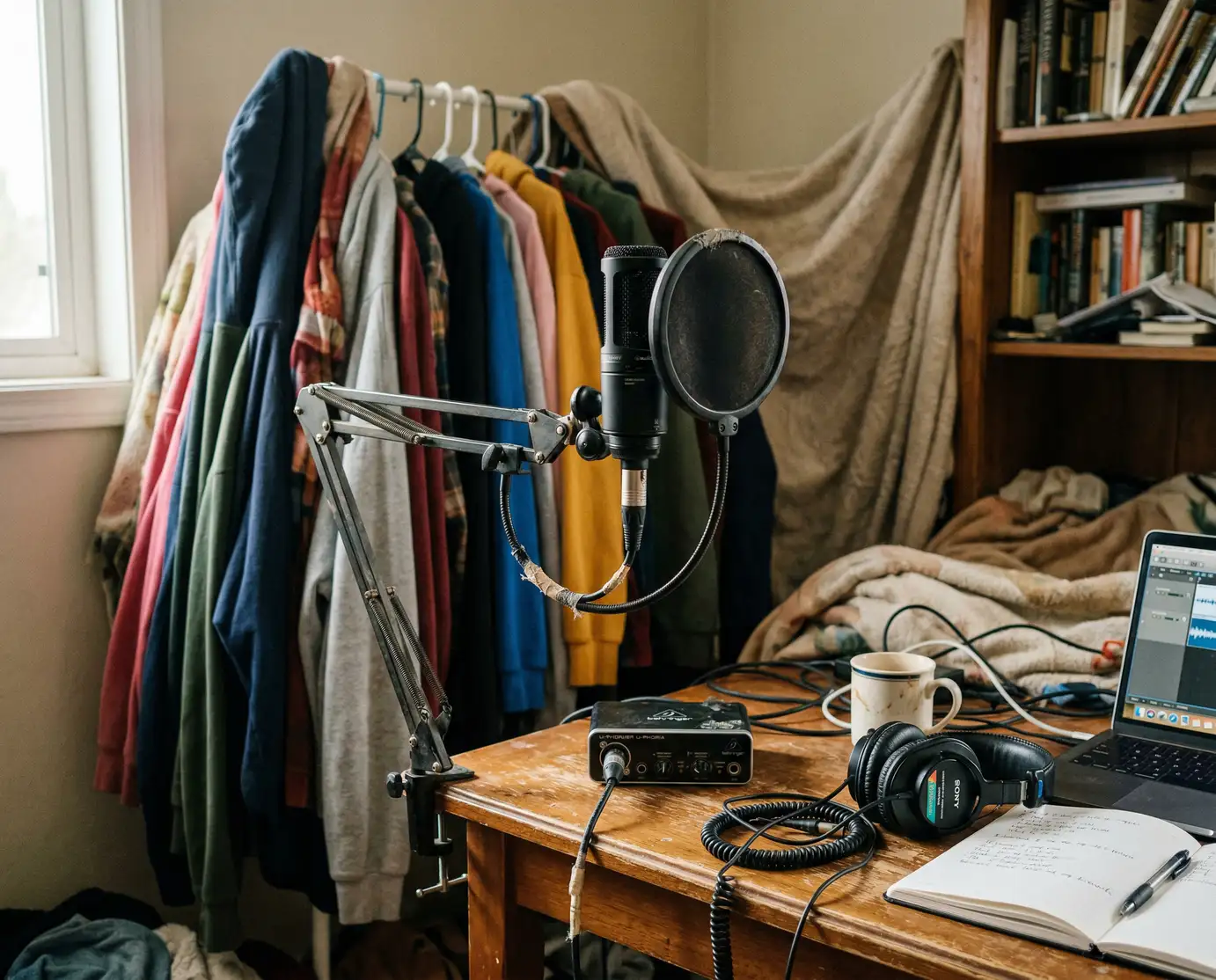
Closets filled with clothes work well. Small rooms with soft surfaces help. Even a corner with blankets can make a difference.
The first time I improved my recording space, I remember feeling a mix of relief and frustration. Relief because the audio finally sounded clean. Frustration because I realized how much time I had wasted fixing bad recordings.
You can keep this simple.
A USB microphone is enough to start. Something in the mid range works fine for beginners.
You will also need headphones to monitor your audio and basic recording software.
Many people start with free tools like Audacity. It is not flashy, but it works.
Do a few test recordings before committing to a full session.
Do not try to record the whole book in one go.
Your voice will change as you get tired. Your pacing will drift. Your mistakes will increase.
I like to break it into sessions of 30 to 60 minutes.
And always record a short “tone sample” at the beginning of each session. Just a few seconds of silence in your recording environment. This helps later during editing when you need to smooth transitions.
You do not need to become a professional voice actor, but a few habits make a big difference.
Sit or stand with good posture so your breathing is steady.
Keep your mouth a consistent distance from the mic.
Smile slightly when reading. It sounds strange, but it changes your tone in a good way.
And mark your script.
I often highlight pauses, emphasis, or tricky words ahead of time. It keeps you from stumbling mid sentence.
You will mess up lines. Everyone does.
Do not stop the recording completely each time. Instead, pause, repeat the sentence cleanly, and continue.
Later, during editing, you can cut the mistake.
This keeps your sessions flowing and saves time.
This is the part most people underestimate.
You will remove mistakes, adjust volume levels, reduce background noise, and smooth transitions between clips.
At first, it feels tedious. You listen to your own voice over and over again, which can be uncomfortable.
I remember thinking, “Do I really sound like this?” That moment hits almost everyone.
But you get used to it.
Editing also teaches you how to record better next time. You start noticing patterns like mouth clicks, breathing noises, or inconsistent pacing.
If you plan to distribute your audiobook, you need to meet certain requirements.
Most platforms expect:
Consistent volume levels
Clean audio with minimal background noise
Specific file formats like MP3
Separate files per chapter
You do not need to memorize everything at once, but be aware that these standards exist.
Skipping this step can lead to rejected uploads later, which is frustrating after all that work.
This is where things start to feel more manageable.
A basic workflow might look like this:
Prepare script
Record session
Do a rough edit
Take a break
Come back for a final edit
Spacing it out helps your ears reset. When you listen fresh, you catch issues you missed before.
Most audiobooks include a short intro and outro.
This usually covers the title, author name, and any credits.
Keep it simple and consistent.
If you are building a larger audio library, these elements also help create a recognizable structure across your content.
Even though it is an audio product, visuals still matter.
Your cover will show up on platforms, apps, and subscriber libraries.
You can reuse your eBook cover, but make sure it is optimized for square formats and smaller displays.
Clear typography matters more than detailed artwork.
Export each chapter as a separate file.
Name them clearly and consistently.
Something like:
Chapter_01_Introduction.mp3
Chapter_02_Getting_Started.mp3
This makes uploading and managing your files much easier.
It also helps if you later want to bundle your audiobook into a subscriber content library.
You have a few options.
Platforms like Audible through ACX are still common. There are also alternatives like Findaway Voices.
But here is something more creators are exploring now.
Hosting your audiobooks inside your own ecosystem.
That could be a membership site, a private app, or a subscriber library where people get access to multiple titles.
This gives you more control over pricing, packaging, and audience relationships.
This is where things get interesting.
Once you go through the process once, you realize you now have:
A narrated version of your book
Raw audio files you can repurpose
Content that can be split into smaller segments
You can turn chapters into podcast episodes, bonus content, or subscriber-only material.
I have seen creators build entire libraries this way over time.
People often ask how long this takes.
For a short book, you might spend:
1 week preparing and recording
1 to 2 weeks editing
A few days handling cover and uploads
For longer books, it stretches out.
And that is okay.
Rushing usually leads to poor audio quality, which is hard to fix later.
Here’s where most people get stuck.
They record in a noisy environment and try to fix it in editing.
They skip the read-aloud manuscript pass and end up re recording sections.
They underestimate editing time and lose momentum halfway through.
Or they obsess over perfection and never finish.
You do not need studio level perfection to create something valuable.
You need clarity, consistency, and a finished product.
I would focus more on workflow than gear.
It is tempting to spend money on better microphones, plugins, and tools.
But a clean process matters more.
I would also start smaller.
Instead of jumping straight into a full length audiobook, I might record a short piece first. A guide, a mini book, or a few chapters.
That builds confidence fast.
Audiobooks are not just an add-on anymore.
They are part of a broader content strategy.
If you are building a digital publishing presence, having your work available in text and audio expands how people engage with it.
Some readers prefer listening during commutes, workouts, or downtime.
Others like switching between formats.
And if you are building a subscription based content library, audiobooks can become one of your core offerings.
They sit alongside eBooks, guides, and other digital assets as part of a growing catalog.
Creating an audiobook from scratch is not as simple as reading into a microphone.
But it is also not as complicated as it first feels.
The first one is always the hardest.
You will second guess your voice, get frustrated with editing, and probably redo parts you thought were fine.
That is normal.
Once you finish one, everything after that becomes more manageable.
And that is when it starts to feel less like a project and more like a system you can build on.